
Raghav Chadha’s Bold Call: Free AI Tools for Every Indian
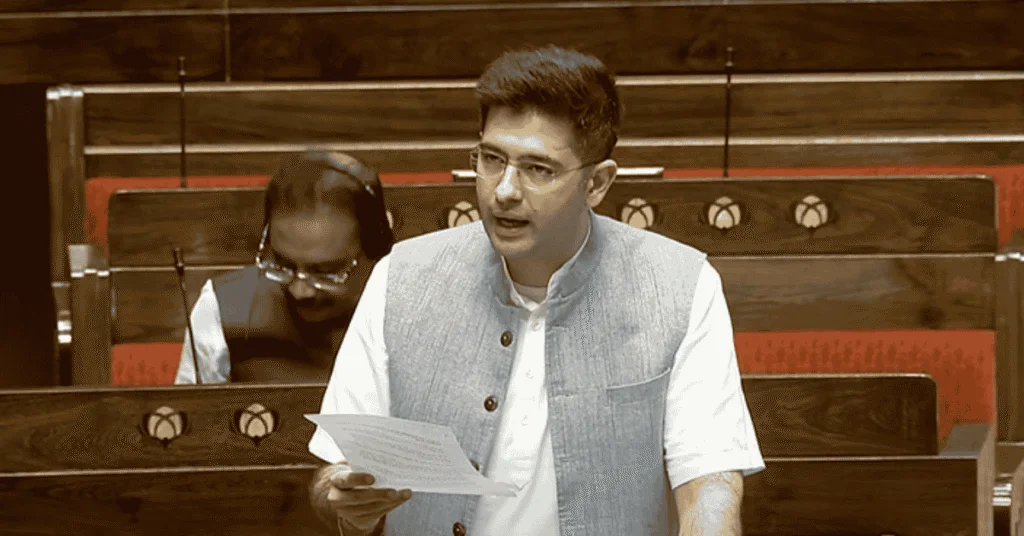
In a passionate and forward-looking speech in the Rajya Sabha, Aam Aadmi Party (AAP) MP Raghav Chadha made headlines by urging the Indian government to provide free subscriptions to advanced AI tools like ChatGPT, Gemini, Claude, and Grok for every Indian citizen.
Table of Contents

Why Free AI Tools Matter
Artificial Intelligence (AI) is rapidly transforming industries, education, healthcare, and even daily life. From automating tasks to enhancing productivity, AI tools are becoming essential. But as Chadha pointed out, access to these tools remains limited due to high subscription costs, especially in a country with over 140 crore people.
“AI is an opportunity for every Indian of every social strata and age. This would be a step towards a true ‘Digital India’,” Chadha said in Parliament.
He emphasized that nations like UAE, Singapore, and China already provide free access to advanced AI tools, and India must not lag behind. According to Chadha, by 2030, AI is expected to contribute $15 trillion to the global economy, and India must be ready to participate fully.
The Global AI Race: Where Does India Stand?
Chadha’s speech wasn’t just about access—it was also a wake-up call. He highlighted how India is currently a consumer of AI, not a producer, despite having the talent and infrastructure to lead.
“America has its indigenous models like ChatGPT, Gemini, Anthropic, and Grok. China has DeepSeek. But where does India stand in this AI era?”
He asked Between 2010 and 2022, the United States registered 60% of global AI patents, China 20%, while India managed only 0.5%, despite being the world’s fifth-largest economy. Chadha stressed that India has over 90 crore internet users and a large AI workforce, with 4.5 lakh Indian AI professionals working abroad.
This brain drain, he argued, is a missed opportunity. India has the talent, but lacks the infrastructure and investment to retain and empower it.
A Roadmap for India’s AI Future
To address these challenges, Chadha proposed a comprehensive roadmap:
- Develop indigenous AI chips
- Launch domestic chip manufacturing
- Create a dedicated AI infrastructure fund
- Offer AI research grants
- Provide AI tax breaks
- Prevent talent migration
- Ensure access to large datasets for Indian startups
“India must become an AI producer in this era of AI and not an AI consumer,” Chadha declared.
He also cited OpenAI founder Sam Altman’s controversial remark that India’s AI potential was “completely hopeless,” using it as a rallying cry for change.
The Case for Free AI Subscriptions
Chadha’s proposal for free AI subscriptions is rooted in the belief that AI should be a universal resource, not a luxury. He argued that access to tools like ChatGPT and Claude can democratize technology, making it easier for Indians to learn coding, analyze data, fill forms, and more.
“Be it coding, studying data analytics, or simply filling up a form… AI would help us do these jobs with more ease,” he said.
He warned that without free access, Indians risk being left behind in the global race, especially as AI becomes central to education, employment, and innovation.
Full Speech Transcript of Raghav Chadha: A Call for Digital Equality
“Thank you, Sir, for permitting me to raise an important issue under special mention.
My subject is the demand for a free subscription to advanced generative AI tools for all Indians. Every citizen of India should be given a free subscription to advanced generative AI tools.Today, the world is changing very rapidly. In this changing world, AI is not just a technology, but an opportunity—an opportunity to move forward, to dream, and to fulfill those dreams.
For our farmer brothers, it is smart farming; for students, it is a 24/7 available tutor; for business people, it is a business planner; for the youth, it is a career guide; and for the elderly, it is also a doctor. AI has the answer to your every question, the solution to your every problem.
This is the reason, Sir, that today countries like the UAE, Singapore, and China are providing their citizens with advanced AI services, free access, and free subscriptions. Meanwhile, in India, where 1.4 billion dreams are nurtured, people are deprived of these advanced AI tools simply because they are expensive.
Research says that by 2030, artificial intelligence will create $15 trillion in value. If we do not prepare for this race now, forget about becoming the winner, India will be left far behind.
If the Government of India provides every citizen with free and secure access to advanced generative AI tools like ChatGPT, Gemini, Grok, and Claude in local languages for all ages and classes, it could multiply the country’s productivity and save people’s valuable time. Whether it’s writing code, data analytics, or filling out a government form, all these tasks can be done more easily and quickly with the help of AI.
This is the next step towards digital democracy, ensuring that no Indian is left behind in this artificial intelligence revolution and that India truly becomes a Digital India.
My demand from the government is that attention be paid to this issue. Jai Hind.”
Government Response: Still Awaited
As of now, there has been no official response from the Indian government to Chadha’s proposal. However, his speech has sparked widespread discussion in tech circles, policy forums, and social media.
Prime Minister Narendra Modi, in a recent address at the Artificial Intelligence Summit in Paris, acknowledged AI’s potential in sectors like health, agriculture, and education. But Chadha’s call goes further—he wants AI to be embedded in everyday life for every Indian, not just in elite institutions or corporate boardrooms.
Full Speech Video of Raghav Chadha in Rajyasabha
In Parliament today, I urged that every Indian be given Free Subscription of Advanced AI Tools like ChatGPT, Gemini, Claude & others pic.twitter.com/RbpZDGdPOS
— Raghav Chadha (@raghav_chadha) August 20, 2025
In Parliament today, I urged that every Indian be given Free Subscription of Advanced AI Tools like ChatGPT, Gemini, Claude & others pic.twitter.com/RbpZDGdPOS
— Raghav Chadha (@raghav_chadha) August 20, 2025
Public Reaction and Industry Buzz
The tech community has largely welcomed Chadha’s proposal. Many experts believe that free access to AI tools could unlock massive innovation, especially among students, small businesses, and rural entrepreneurs.
Some skeptics, however, question the feasibility of such a move. Providing free subscriptions to tools developed by global tech giants like OpenAI and Google could involve significant licensing costs. Others argue that India should focus on building its own AI tools, rather than relying on foreign platforms.
But Chadha’s vision includes both: access now, and production later. His dual push for “Free AI Tools” and “Make AI in India” reflects a balanced strategy—empower citizens today, build national capacity tomorrow.
Global Context
India isn’t alone in grappling with this question. Around the world, nations are debating how to integrate AI into society without excluding vast populations:
- European Union: The EU is pushing regulations alongside investments in open-source AI tools that can be accessed freely.
- United States: While private AI firms dominate, some universities are pushing to provide campus-wide AI subscriptions for students.
- China: The government has heavily invested in developing domestic, affordable AI models to reduce reliance on foreign technology and ensure every citizen can access some form of AI assistant.
If India were to act on Chadha’s suggestion, it would likely become the first country in the Global South to declare AI a universal right, akin to access to education.
Google Offers Free AI Pro Subscription for Indian Students
In a promising development, Google has started offering free access to its powerful AI Pro tools for students in India. This initiative aims to empower the next generation of learners with cutting-edge AI capabilities, helping them with tasks like research, writing, coding, and more.
Students can now access tools like Gemini AI and other Google AI services at no cost, provided they meet the eligibility criteria.
???? How to Access Google’s Free AI Subscription:
Visit the official guide here: Google AI Pro Now Free for Students: How to Access in 5 Min
Conclusion: A Vision Worth Supporting
Raghav Chadha’s speech is a call to action. It’s about making AI a public utility—accessible, affordable, and empowering. Whether the government acts on this proposal remains to be seen, but the conversation has begun.
“This is the next step towards digital democracy,” Chadha concluded.
“Let no Indian be left behind in the AI revolution.”
For more tech news, subscribe to us.
Last updated on August 20, 2025 at 1:51 pm


