Meta’s New Supercluster: Inside the Manhattan-Sized AI Center [2025]
![dda83160b2e0f89f237042c02373ea5e6f256d8d8151faf3e7999246228ea93a?s=48&d=mm&r=g Meta's New Supercluster: Inside the Manhattan-Sized AI Center [2025]](https://secure.gravatar.com/avatar/dda83160b2e0f89f237042c02373ea5e6f256d8d8151faf3e7999246228ea93a?s=48&d=mm&r=g "Meta's New Supercluster: Inside the Manhattan-Sized AI Center [2025] 2")
Superclusters are no longer just astronomical phenomena; they’re now Meta’s ambitious approach to powering the future of artificial intelligence. The tech giant is constructing AI data centers of astronomical proportions, with one facility planned to cover an area nearly the size of Manhattan (59.1 sq km). This unprecedented scale reflects Meta’s commitment to developing what it calls “superintelligence” – technology capable of outthinking the smartest humans.
According to recent announcements, Meta will invest hundreds of billions of dollars in developing AI products and infrastructure. At the heart of this strategy are two groundbreaking projects – Prometheus and Hyperion. The first multi-gigawatt data center, Prometheus, is expected to come online in 2026 with 1 gigawatt of computational power, while Hyperion aims to deliver up to 5 gigawatts across multiple phases [-5]. For context, one gigawatt corresponds to the electricity use of approximately one million households.
In this article, we’ll explore Meta’s vision for these massive AI superclusters, examine the technical specifications of Prometheus and Hyperion, and analyze what this investment means for the future of artificial intelligence development.
Meta’s AI Supercluster Vision
Meta’s grand vision extends far beyond mere computational power—it represents a fundamental shift in how AI infrastructure is conceptualized. Unlike traditional data centers scattered across various locations, these massive AI hubs embody a centralized approach to solving humanity’s most complex problems through machine learning at unprecedented scales.
Behind this ambitious undertaking lies CEO Mark Zuckerberg’s unwavering belief in “superintelligence” as the ultimate technological milestone. He envisions these superclusters as the breeding grounds for AI systems that will eventually surpass human capabilities across virtually all domains of knowledge and creativity.
The supercluster strategy revolves around three core principles: scale, efficiency, and future-proofing. By concentrating resources in these mega-facilities rather than distributing them, Meta aims to create optimal environments for AI model training that maximize computational density while minimizing latency issues that plague distributed systems.
These superclusters aren’t merely technical achievements—they represent Meta’s philosophical stance on AI development. The company believes that true breakthroughs in artificial general intelligence will come not from incremental improvements but from quantum leaps in computational capacity. This “go big or go home” mentality drives their investment strategy.
From a business perspective, these facilities position Meta to potentially dominate the next era of computing. By owning the infrastructure that powers the most advanced AI systems, they could offer services to other companies unable to match this scale of investment, creating new revenue streams beyond their current social media empire.
The timeline for this vision extends well into the 2030s, with these initial superclusters representing just the beginning. Meta foresees a future where such facilities form the backbone of a new kind of digital infrastructure—one that processes not just data but knowledge itself at planetary scales.
For researchers and developers, these superclusters promise to dramatically accelerate innovation cycles, potentially compressing years of trial-and-error into weeks or days, fundamentally changing how AI research progresses.
Inside Prometheus and Hyperion
Mark Zuckerberg has pulled back the curtain on Meta’s colossal supercluster duo, revealing physical dimensions that defy conventional data center scales. The sheer magnitude of these facilities is staggering—each titan cluster will cover an area comparable to a significant portion of Manhattan, with one facility stretching approximately 6.5 miles (10.5 km) and occupying about 80% of Manhattan’s 2.5-mile width.
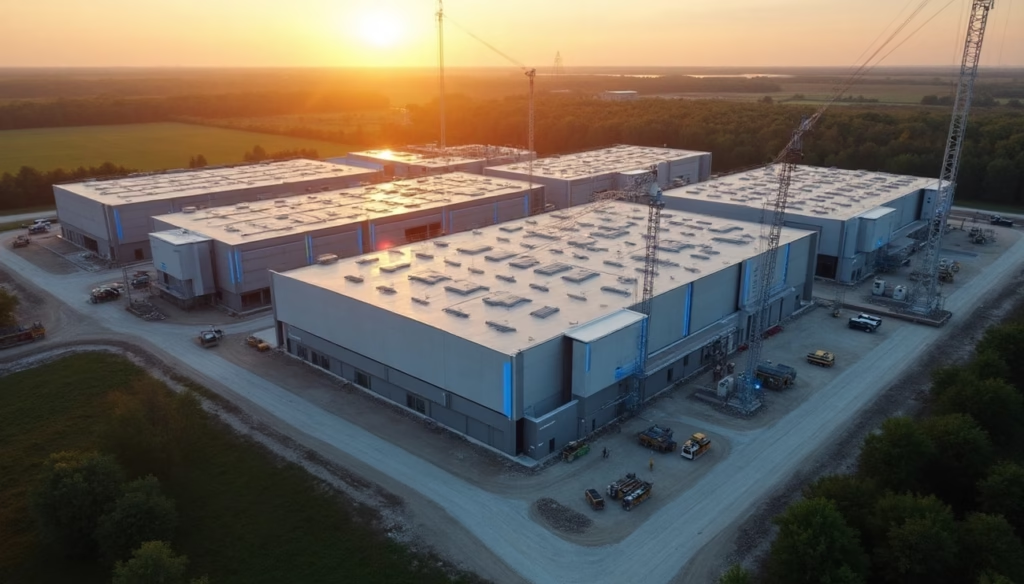
Prometheus, Meta’s first supercluster, is currently under construction in New Albany, Ohio and represents a technological milestone in AI infrastructure. Scheduled to come online in 2026, this 1-gigawatt computational powerhouse combines Meta-owned systems with leased infrastructure. Notably, Prometheus employs gas turbines and features an innovative design focused on rapid deployment, positioning Meta to become the first AI lab to bring a gigawatt-plus supercluster online.
Simultaneously, Meta is developing Hyperion in Richland Parish, Louisiana, an even more ambitious project designed to scale up to 5 gigawatts over several years. First announced as a four-million-square-foot campus, Hyperion’s initial 1.5-gigawatt phase is expected to be operational by 2026, with complete construction extending to 2030. This installation represents an unprecedented leap in computational scale—for comparison, the largest current facility (China Telecom Inner Mongolia Park) boasts a capacity of merely 0.15 gigawatts.
To accelerate construction, Meta has adopted prefabricated cooling modules and lightweight structures. Additionally, both superclusters will utilize a combination of renewable energy and natural gas, highlighting Meta’s pragmatic approach to balancing speed and sustainability. Nevertheless, environmental concerns remain significant—similar facilities have been reported to consume up to 10% of a county’s water supply.
Beyond these flagship projects, Zuckerberg confirmed that Meta is developing “multiple more titan clusters”, each designed to provide what he describes as “industry-leading levels of compute and by far the greatest compute per researcher”. These facilities represent not merely incremental improvements but a fundamental reimagining of computational infrastructure scale—effectively creating digital cities dedicated solely to advancing artificial intelligence capabilities.
The Technology Behind the Superclusters
Powering these colossal AI superclusters requires cutting-edge technology across multiple domains. At the heart of Meta’s computational infrastructure lies a massive deployment of NVIDIA’s most powerful GPUs, with plans to incorporate 350,000 H100 GPUs by the end of 2024 as part of a portfolio featuring compute power equivalent to nearly 600,000 H100s. These GPUs are organized into clusters of 24,576 units each, creating some of the largest AI training environments ever constructed.
Meta isn’t relying solely on third-party hardware, however. The company has developed its own Meta Training and Inference Accelerator (MTIA), a custom silicon solution specifically designed for Meta’s unique AI workloads. This next-generation chip demonstrates a 3x performance improvement over its predecessor across key models and provides 6x model serving throughput at the platform level.
For network infrastructure, Meta employs two distinct approaches: RDMA over Converged Ethernet (RoCE) and NVIDIA Quantum2 InfiniBand fabric, both interconnecting at 400 Gbps. Storage needs are addressed through Meta’s “Tectonic” distributed storage solution optimized for Flash media.
Perhaps most crucial is how these facilities will be powered. Meta recently signed a 20-year agreement with Constellation Energy for 1,121 megawatts of nuclear energy from the Clinton Clean Energy Center starting in 2027. Furthermore, the company has received over 50 qualified submissions for its Request for Proposals aimed at catalyzing 1-4 gigawatts of new nuclear energy projects.
Cooling these power-hungry systems presents another engineering challenge. Meta has shifted toward liquid cooling technologies, implementing cold plates for direct-to-chip cooling and Air-Assisted Liquid Cooling (AALC) with rear-door heat exchangers. This cooling infrastructure is essential as rack power densities increase to accommodate AI workloads that generate significantly more heat than traditional computing systems.
Conclusion
Meta’s supercluster initiative stands as a watershed moment in AI infrastructure development. These Manhattan-sized facilities represent far more than mere data centers; they embody a fundamental shift in how computational power will drive future AI advancement. Prometheus and Hyperion, with their combined capacity of up to 6 gigawatts, will likely reshape our expectations of what large-scale AI systems can accomplish.
The technological innovations underpinning these superclusters deserve equal attention. Meta’s deployment of hundreds of thousands of NVIDIA GPUs alongside their custom MTIA chips demonstrates their commitment to building specialized infrastructure rather than simply scaling existing solutions. Additionally, their cooling and power strategies address the enormous energy demands these facilities create while attempting to balance speed of deployment with environmental considerations.
Though questions remain about the environmental impact and practicality of such concentrated computing power, Meta clearly believes centralized superclusters offer advantages that distributed systems cannot match. Their vision positions these digital behemoths as the foundation for achieving superintelligence—AI systems potentially capable of outthinking the brightest human minds.
Meta’s bold investment signals a new phase in the AI arms race. While 2026 might seem distant, the computational landscape will look dramatically different once these facilities come online. Companies without access to similar resources may find themselves at a significant competitive disadvantage. Nevertheless, these superclusters might ultimately benefit the broader tech ecosystem, potentially accelerating breakthroughs across numerous fields from medicine to climate science.
The path toward superintelligence remains uncertain, but Meta has certainly committed to building the infrastructure they believe will get us there. Their supercluster strategy represents both a technological marvel and a significant bet on the future direction of artificial intelligence development.
Key Takeaways
Meta is revolutionizing AI infrastructure with unprecedented scale and ambition, building computational facilities that could reshape the future of artificial intelligence development.
• Meta is building Manhattan-sized AI superclusters with Prometheus (1 GW, 2026) and Hyperion (5 GW) representing the largest AI facilities ever constructed
• Massive GPU deployment powers these facilities with 350,000+ NVIDIA H100 GPUs plus custom MTIA chips creating industry-leading compute per researcher
• Nuclear energy partnerships ensure sustainable power through 20-year agreements providing over 1 GW of clean energy to support these power-hungry operations
• Centralized supercluster strategy aims for superintelligence by concentrating resources rather than distributing them, potentially accelerating AI breakthroughs by years
• First-mover advantage in gigawatt-scale computing positions Meta to dominate the next era of AI development and offer services to companies unable to match this investment
This infrastructure investment represents Meta’s belief that true AI breakthroughs require quantum leaps in computational capacity rather than incremental improvements, fundamentally changing how AI research progresses and potentially creating new competitive dynamics in the tech industry.
Follow our Tech Category for more updates.
Last updated on July 22, 2025 at 3:12 pm