
Musk Accuses Apple of Favoring OpenAI ChatGPT
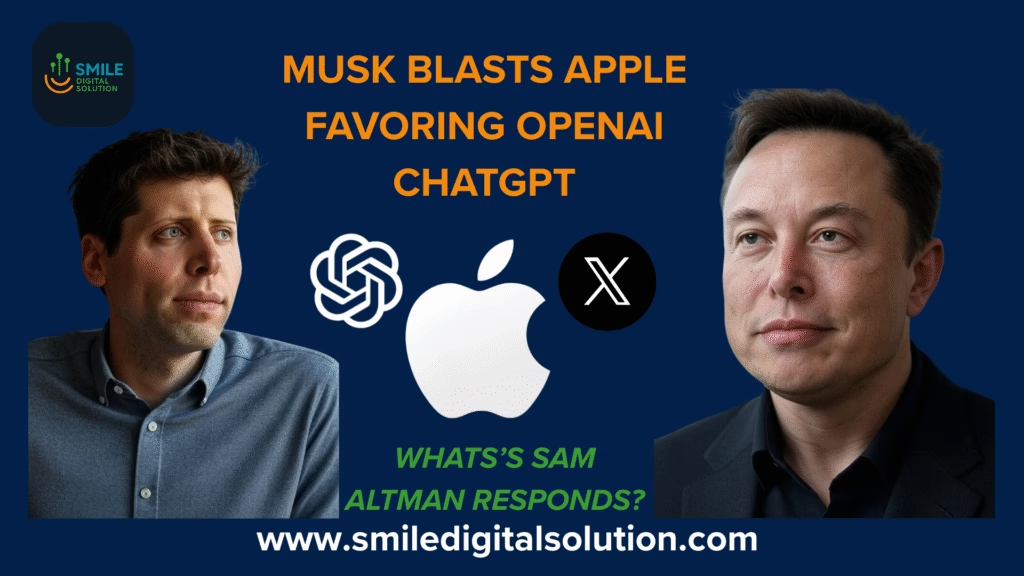

Elon Musk, the CEO of his artificial intelligence startup xAI, has publicly accused Apple of unfairly favoring OpenAI’s ChatGPT app in the App Store rankings, claiming this creates an antitrust violation environment that stifles competition against any AI company besides OpenAI. Musk has announced that xAI will take immediate legal action against Apple over these allegations, highlighting the ongoing tensions between the tech giant and Musk’s AI ventures.

Apple’s Alleged Favoritism Toward OpenAI
Musk’s grievances center on how Apple manages its App Store rankings, particularly in the AI app category. He asserts that Apple has been privileging OpenAI’s ChatGPT, which currently sits at the No. 1 spot in the “Top Free Apps” section of Apple’s US App Store for iPhones, holding a dominant position for nearly a year. Meanwhile, Musk’s own app, Grok — developed by xAI — though it has climbed in ranks significantly, reaching around fifth place, has not received comparable editorial support or prominent placement.
Musk took to his social media platform X (formerly Twitter) to voice his concerns directly to Apple:
“Hey @Apple App Store, why do you refuse to put either X or Grok in your ‘Must Have’ section when X is the #1 news app in the world and Grok is #5 among all apps? Are you playing politics? What gives? Inquiring minds want to know.”
Hey @Apple App Store, why do you refuse to put either ???? or Grok in your “Must Have” section when ???? is the #1 news app in the world and Grok is #5 among all apps?
— Elon Musk (@elonmusk) August 11, 2025
Are you playing politics? What gives? Inquiring minds want to know. https://t.co/3wenLZGtwG
His accusation includes a broader claim that Apple’s practices make it practically impossible for any AI company other than OpenAI to rise to the top position in App Store rankings, which Musk calls an unequivocal antitrust violation.

OpenAI CEO Sam Altman’s Take on the Apple-xAI Dispute
In the ongoing public dispute, Sam Altman, CEO of OpenAI, added a noteworthy perspective in a recent post on X. Altman.
Altman tweeted:
This is a remarkable claim given what I have heard alleged that Elon does to manipulate X to benefit himself and his own companies and harm his competitors and people he doesn’t like.
This is a remarkable claim given what I have heard alleged that Elon does to manipulate X to benefit himself and his own companies and harm his competitors and people he doesn't like. https://t.co/HlgzO4c2iC
— Sam Altman (@sama) August 12, 2025
Grok vs. ChatGPT: The Battle for AI Supremacy
xAI’s Grok 4, released last month, introduced significant upgrades in performance and capabilities. The company also launched Grok Imagine, an image and video generation tool, and customizable “companion” chatbots. These innovations helped Grok gain traction among users, especially after xAI made the app free globally.
However, OpenAI’s ChatGPT has maintained a dominant position on the App Store for over a year. It consistently ranks at or near the top of Apple’s charts and enjoys frequent editorial features. More notably, Apple recently partnered with OpenAI to integrate ChatGPT into its new Apple Intelligence suite, which includes Siri enhancements and writing tools for iOS, iPadOS, and macOS.
This partnership, Musk argues, creates a conflict of interest that undermines fair competition.
A History of Conflict: Musk vs. OpenAI
Musk’s grievances with OpenAI are not new. He co-founded the organization in 2015 but parted ways in 2018 due to strategic differences. Since then, he has criticized OpenAI’s shift toward a for-profit model and even filed a lawsuit against the company and its CEO, Sam Altman, alleging a betrayal of its original mission to develop AI “for the benefit of humanity.”
The current dispute with Apple appears to be an extension of this broader conflict. Musk sees Apple’s platform as a gatekeeper that can skew competitive outcomes in favor of entrenched players like OpenAI.
Editorial Favoritism and App Store Rankings
According to data from App Figures, Grok’s rise in the App Store rankings has been impressive. Yet, Musk claims that Apple’s editorial decisions continue to favor ChatGPT, regardless of Grok’s performance. He specifically pointed out the absence of Grok and X from the “Must-Have Apps” section, despite their high rankings.
This tweet underscores Musk’s belief that Apple’s curation practices are not based solely on merit or user engagement but are influenced by corporate alliances.
Background and Context: The Musk-OpenAI-Apple Triangle
Elon Musk was one of the original co-founders of OpenAI in 2015 but left the organization in 2018, later criticizing it for abandoning its nonprofit origins and its mission to responsibly develop AI for the public good. Since then, Musk has launched his own AI company, xAI, which developed Grok, an AI chatbot designed to compete directly with ChatGPT. The rivalry extends not only between the AI companies but also involves Apple, which has partnered closely with OpenAI by integrating ChatGPT’s capabilities into Apple products such as iPhones, iPads, and Macs, notably enhancing Apple’s virtual assistant Siri with ChatGPT-powered AI features.
Apple’s editorial content in the App Store has prominently featured ChatGPT and continues to promote it heavily, while Grok and Musk’s related app X often don’t receive the same level of visibility. This has fueled Musk’s attributions of political favoritism and unfair competitive practices by Apple.
Legal and Regulatory Implications
Musk’s legal threat against Apple comes amid increasing scrutiny over Apple’s App Store policies, which have faced antitrust investigations and penalties globally. Apple is currently dealing with lawsuits and fines regarding monopolistic behavior, including a $2 billion fine by the European Union for unfairly favoring its own music streaming service and restrictions preventing developers from directing users to cheaper payments outside the App Store.
The US Department of Justice and several states have also filed antitrust lawsuits against Apple, challenging its control over the app ecosystem and alleged anti-competitive practices.
In this ongoing backdrop, Musk’s announcement that xAI will sue Apple specifically for App Store rankings bias highlights a new front in these disputes, potentially intensifying legal battles over tech company monopolies and app store fairness.
What This Means for the AI Marketplace
The controversy shines a spotlight on the competitive challenges emerging in the AI application market, where platform gatekeepers like Apple wield immense influence over which apps gain visibility and traction with consumers. Musk’s xAI and Grok represent a new challenger to OpenAI’s dominance, but alleged barriers erected by Apple’s curation practices threaten to inhibit innovation and fair competition.
If Musk’s claims have merit and lead to legal victories or regulatory action, this might compel Apple to revise its App Store policies to foster a more equitable environment for AI developers. It could also open broader discussions about the role and responsibility of major platforms in ensuring competitive neutrality and transparency in app promotion and ranking systems.
Apple’s Silence and Industry Reactions
As of this writing, Apple has not issued an official response to Musk’s accusations. The company’s partnership with OpenAI, however, is well-documented. Apple Intelligence, unveiled earlier this year, integrates ChatGPT directly into Siri and other system-level features, making OpenAI’s technology a core part of the Apple ecosystem.
Industry analysts suggest that Apple’s deepening ties with OpenAI could invite regulatory scrutiny, especially if Musk proceeds with legal action. Antitrust regulators in the U.S. and EU have already expressed interest in examining platform favoritism and the role of app store curation in shaping market dynamics.
Conclusion
Elon Musk’s bold accusation that Apple favors OpenAI’s ChatGPT over competing AI products in its App Store rankings marks a significant escalation in the battle between leading AI firms and tech platform giants. His call for immediate legal action underscores serious antitrust concerns that could reshape the rules governing AI app visibility and competition within dominant ecosystems like Apple’s.
Whether Musk’s case advances successfully through courts or regulatory channels remains to be seen, but it unquestionably raises critical questions about fairness, market power, and the role of platform gatekeepers in the fast-evolving AI landscape.
For more tech news, subscribe to us.
Last updated on August 12, 2025 at 11:58 am


