
AI Discovers 5 Materials Revolutionizing Battery Technology
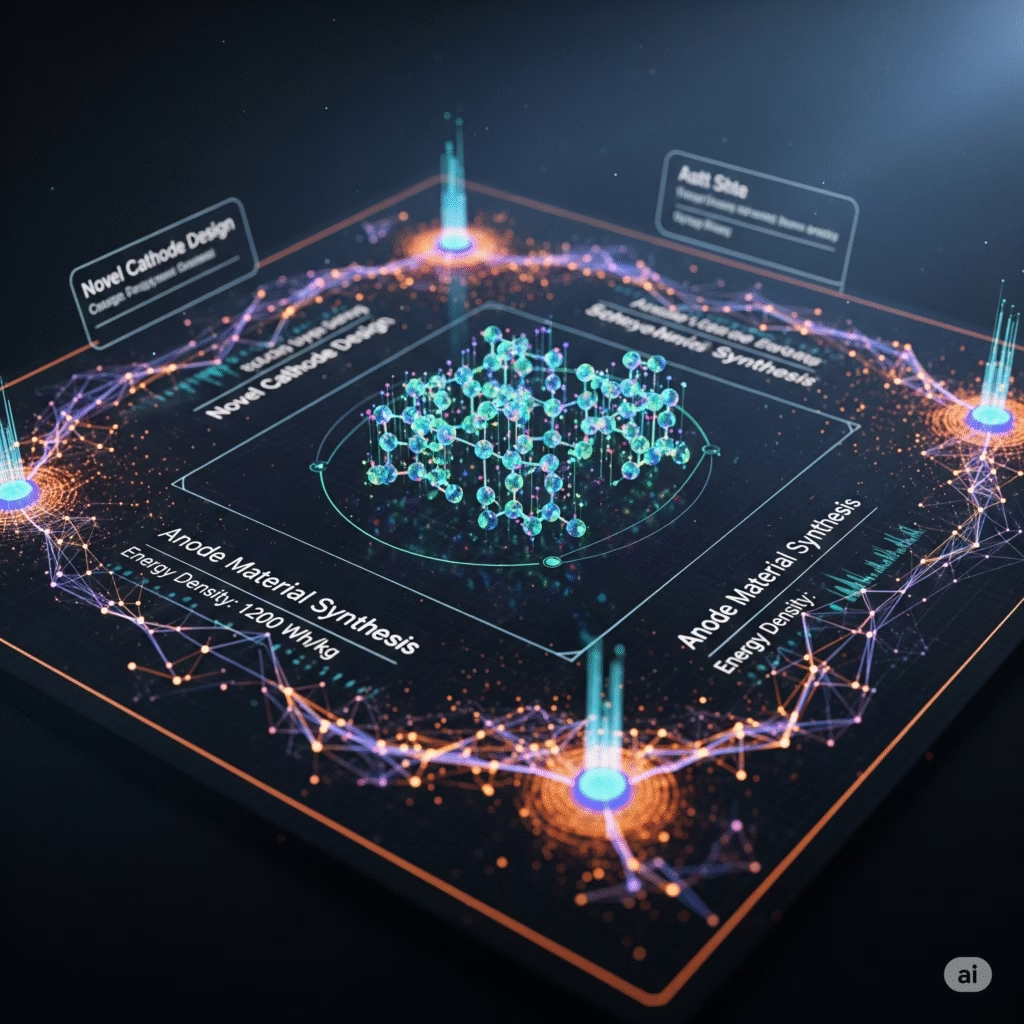

Artificial intelligence (AI) is once again pushing the boundaries of innovation by discovering five new materials with the potential to revolutionize battery technology. This breakthrough could reshape the future of energy storage, accelerating the shift towards sustainable, high-performance batteries that may ultimately replace today’s lithium-ion technology.
The Urgent Need for Better Batteries
Lithium-ion batteries have powered everything from smartphones to electric vehicles for years but face critical challenges. Lithium is a relatively scarce and expensive resource, and its extraction and use raise environmental concerns. Moreover, lithium-ion batteries have limitations in energy density and safety, with issues like dendrite formation risking battery life and performance.
The global demand for energy storage technologies that are more sustainable, powerful, affordable, and environmentally friendly has never been higher. To meet this demand, scientists are exploring alternative battery chemistries that rely on more abundant elements such as magnesium, calcium, aluminum, and zinc.
AI-Powered Material Discovery: The Game Changer
Discovering new materials for batteries traditionally involves time-consuming and costly trial-and-error experiments. AI dramatically accelerates this process by quickly analyzing vast chemical and crystallographic data sets to identify promising candidates.
Recently, a team at the New Jersey Institute of Technology (NJIT), led by Professor Dibakar Datta, leveraged advanced AI techniques to tackle the complex challenges of multivalent-ion batteries. Multivalent ions can carry two or three positive charges, potentially storing much more energy than lithium ions, but their larger size has made suitable battery materials difficult to find.
Using a novel dual-AI system combining a Crystal Diffusion Variational Autoencoder (CDVAE) and a tuned Large Language Model (LLM), the researchers sifted through thousands of possible crystal structures. This AI-driven approach enabled them to discover five previously unknown porous transition metal oxide materials with large open channels—essential for efficiently transporting bulky multivalent ions safely and quickly.
Why These 5 New Materials Matter
These five materials exhibit several critical qualities that could transform battery technology:
- Enhanced Energy Density: By accommodating multivalent ions such as magnesium or zinc, these materials can enable batteries with significantly higher energy storage capacity compared to traditional lithium-ion batteries.
- Improved Safety and Stability: The large porous channels in these materials help prevent the formation of damaging structures like dendrites, which cause short circuits and battery degradation.
- Environmental and Economic Benefits: Using abundant elements reduces reliance on scarce lithium, lowering costs and environmental impact associated with mining.
- Rapid Ion Movement: The structural design facilitates fast ion transport, enabling quicker charging and discharging cycles.
- Synthesis Feasibility: Quantum mechanical simulations and stability tests confirm that these materials can realistically be synthesized and scaled for practical applications.
Microsoft researchers introduce MatterGen, a model that can discover new materials tailored to specific needs—like efficient solar cells or CO2 recycling—advancing progress beyond trial-and-error experiments. https://t.co/z9yOaV7VGo pic.twitter.com/qrmYHheKlS
— Microsoft Research (@MSFTResearch) January 16, 2025
AI and Supercomputing Speed Up Battery Innovation
The NJIT discovery builds on a growing trend where AI and supercomputers dramatically shorten the time from concept to functional prototype. Microsoft and the Pacific Northwest National Laboratory earlier demonstrated narrowing down millions of potential inorganic materials to a handful of promising candidates in under a week—an endeavor that could have otherwise taken decades with classical approaches. Their breakthrough led to a new battery material that reduces lithium use by up to 70%, showcasing AI’s power to accelerate energy innovation.
Similarly, teams in Singapore and China used AI to identify materials that prevent dendrites in zinc-ion batteries, extending battery life and safety. This AI-powered approach allowed testing over 168,000 material combinations quickly, which would have been impractical with traditional lab methods.
Real-World Implications and Future Prospects
The ripple effects of these five newly discovered materials could be profound across multiple sectors:
- Electric Vehicles: Batteries with superior energy density and safety could extend driving ranges and reduce charging times, accelerating EV adoption worldwide.
- Grid Storage: More efficient and sustainable batteries enable better integration of renewable energies like solar and wind, stabilizing power grids and aiding climate goals.
- Consumer Electronics: Longer-lasting, safer batteries lead to better user experiences and decrease hazardous electronic waste.
- Emerging Technologies: Innovations in drones, robotics, and urban air mobility vehicles require lightweight, high-capacity batteries, making these materials vital enablers.
Companies specializing in AI-driven battery innovation, such as SES AI, are already investing heavily to commercialize these breakthroughs. Their vision encompasses delivering safer, lighter, and more powerful batteries catering to a spectrum of applications from electric transportation to large-scale energy storage.

Challenges Ahead: From Lab to Market
Despite immense promise, transitioning AI-discovered materials from discovery to real-world batteries involves hurdles:
- Synthesis Scalability: Experimental techniques must be refined to economically produce these materials at industrial volumes without quality loss.
- Durability Testing: Long-term cycling under diverse environmental conditions is critical to validate performance and safety claims.
- System Integration: Batteries comprise complex assemblies; new materials must harmonize with electrolytes, electrodes, and manufacturing processes.
- Regulatory Compliance and Consumer Trust: Meeting safety standards and convincing the market of reliability remain key milestones.
As Professor Datta concludes,
“The collaboration between AI experts, chemists, engineers, and industry stakeholders is more crucial than ever to bring these transformative materials from simulations to everyday energy solutions.”
The Broader Impact of AI on Material Science
AI’s rapid analysis of multidimensional data and predictive modeling is revolutionizing how we discover and optimize materials. This approach not only accelerates battery innovation but also paves the way for breakthroughs in electronics, catalysis, and sustainable energy technologies. By condensing what once took decades into months or weeks, AI empowers researchers and businesses to tackle global challenges with unprecedented agility.
The discovery of these five novel battery materials underlines AI’s role as a catalyst in the clean energy revolution. For tech enthusiasts, investors, and policymakers alike, keeping a close eye on this evolving synergy of AI and material science is imperative — it’s reshaping the energy landscape and holds the promise to power a sustainable future.
The Road Ahead: From Lab to Life
While the AI’s predictions are a monumental achievement, this is just the first step. The next phase involves synthesizing these five materials in laboratories to verify their properties. After successful lab tests, the challenge will be to develop manufacturing processes to produce them at scale and integrate them into battery cell prototypes. This process could still take 5 to 10 years before we see the first products hit the market.
However, the fusion of AI with materials science has irrevocably accelerated the pace of innovation. What was once a distant dream—a world powered by safe, cheap, and ultra-powerful batteries—is now a tangible goal on the horizon. This discovery isn’t just about better gadgets; it’s about building a more sustainable and equitable technological future for everyone. Read More from Microsoft Research.
For the latest updates, visit RESEARCH & REPORTS Category.
Last updated on August 2, 2025 at 8:07 pm


